AGV Safety Edge Design
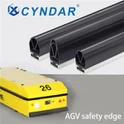
With the continuous development of automation technology, AGVs (Automated Guided Vehicles) have been widely used in various fields, and their operational safety has received increasing attention. To ensure that AGVs can avoid obstacles or stop moving in time during operation, in addition to equipping them with advanced obstacle avoidance devices such as LiDAR and TOF cameras, engineers also design mechanical safety devices on the vehicle surface as a final layer of safety protection. Among these, safety edges, due to their simple structure and high reliability, have become the most commonly used safety device.

◆ Types and Selection of Safety Edges
Currently, there are two main types of safety edges on the market: one is pressure wave switches, which are widely used in products such as Kiwa robots and service robots; the other is conductive rubber strip switches, which are the preferred choice for industrial AGVs and AGV forklifts. However, with the increasingly stringent safety verification of AGV products, such as the widespread adoption of CR or CE certifications, many existing safety edge products on the market may not meet these high safety standards.

So, how to correctly select anti-collision buffer strips for AGV products? The key is to comply with the relevant regulations of EU standard EN1525 and CR safety certification. Specifically, we need to consider the size and force requirements of the test specimens. For example, a specimen with a diameter of 200 mm and a length of 600 mm should not experience a collision force exceeding 750 Newtons when placed perpendicular to the vehicle path or at any other position. Similarly, a specimen with a diameter of 70 mm and a height of 400 mm, placed vertically within the vehicle path, should not experience a collision force exceeding 250 Newtons. Furthermore, the force generated when the bumper is compressed from its maximum speed and load to the bumper stop position should not exceed 400 Newtons.

While adhering to these standards, the design of the safety edge brackets must also include adequate buffer space to ensure that the edge functions effectively in the event of a collision, rather than directly transmitting the impact force to the vehicle's structural components.