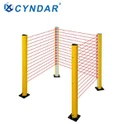
Safety light curtains, also known as photoelectric safety protection devices, are used in modern factories where humans and machines work together. In potentially hazardous machinery such as stamping machines, shearing equipment, metal cutting equipment, automated welding lines, automated assembly lines, mechanical conveying and handling equipment, and hazardous areas (high pressure, high temperature, etc.), worker injuries can easily occur.
Basic parameters of safety light curtains:
1. Beam Spacing: This refers to the distance between the two lamps at the transmitting end or the two lamps at the receiving end, also known as resolution. Generally, the diameter of a human finger is between 12 and 20 mm, so a 10 mm spacing grating is needed to protect the finger. This ensures that the light beam is blocked regardless of the finger's position within the grating, thus protecting the finger. The thickness of the palm is generally between 25 and 40 mm, so a 20 mm spacing grating is needed to protect the palm. The diameter of the arm is generally over 40 mm, and a 40 mm spacing grating is sufficient to protect the arm.
2. Beam Distance: This refers to the maximum distance between the transmitting and receiving ends. This parameter is mainly determined by the size of the protected area. 3. Grating Height: Refers to the height of the equipment that needs protection.
4. Grating Response Speed: Refers to the sensitivity of the grating during operation. The time between detecting a foreign object within the protection zone and issuing a control signal is called the response speed. The faster the response speed, the higher the safety factor.
If the safety light curtain's response time is too slow when it senses an object blocking the light, it can cause workplace accidents. How can we test if the response time is fast enough? We can place a pile of powered products on a flat surface, then drop an object from a height of 2 meters and observe whether the sensor lights react.