Flush on the Outside, Open at Both Ends
A press had a guard door, not a large opening, and the curtain was bought to match its height. Bolted on, the two lined up flush and from the outside there was nothing to criticise. On the trial run someone skipped opening the door and pushed a hand through the gap above the frame to nudge the stock along. The press kept running. The fitter was standing right there, and his face changed - he had assumed that door was finished.
What Protective Height Actually Measures
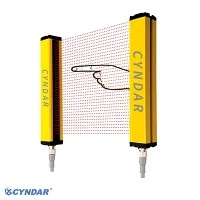
The protective height on a light curtain is not the length of the housing. It is the span between the first beam and the last one. Each end carries a cap, and inside that cap there are no beams, so nothing is being watched there. Every curtain therefore has two lengths - protective height and overall length - and the difference is those two end sections.
The trouble is that only one of those numbers gets looked at when the order is placed. Whatever the opening measures, that is the protective height bought, and matching one to the other feels like the job is done. What got matched was the overall length, not the detection span. From outside the result sits flush. The band inside that detects nothing is not visible to anyone.
A Hand Does Not Come Through the Middle
Nobody reaches in politely through the centre of an opening. When it happens, the hand goes over the top edge to reach the stock, or under the bottom edge to flick a burr clear, and the body stays outside. A curtain across the middle stops a hand that comes straight at it. It does not stop a hand that feels its way along the edge.
The ending on that press was a mild one. The owner changed two things: the curtain moved up so its top end sat on the door frame instead of hanging over the gap, and a plate went on the bottom edge to close the band that was left. On the retest, the same movement lit the red lamp before the hand was through, and the press stopped. Neither change was a new purchase. Both were about where it sits and what closes the gap.
Three Ways to Close It
The first is settled at selection: size the protective height to cover the hazard zone rather than to match the opening, and let each end sit on the frame so the detection span reaches behind it. The cost is that on a small door the curtain ends up longer than the opening, and the mounting position has to move out or the bracket gets remade.
The second is structural: plates, edging or guide rails over both ends to physically close the band that does not detect. The cost is sheet metal work, and a retrofit on an old machine rarely wants to stop for that.
The third is a different model: a no-blind-zone curtain, with beams carried right to the end faces, so the detection span runs almost flush. The cost is price and lead time, and the existing brackets usually have to change with it.
Acceptance Is One Test
Do not sign it off by eye. Have a test piece made to the detection accuracy of that particular curtain, then run it along all four edges of the opening - top, bottom, left, right - right into each corner. The red lamp has to stay lit the whole way; only then is the detection span actually covering the opening. Waving a hand about in the middle is the check most likely to miss the gap along the top.
We build safety light curtains, including a no-blind-zone range with the beams carried to the end faces, and controllers such as the SRC106 with status indication on each channel, so a red lamp says where and why. We are CYNDAR.
A curtain is not guarding because it is mounted. What it covers is the guarding.