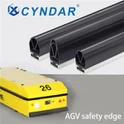
In scenarios prone to collision risks, safety touch edges are crucial. It can sense external pressure, quickly trigger safety protection, and escort personnel and the environment.

Its core function is to detect collisions and respond in time. When the moving parts of the equipment come into contact with objects, it is under pressure to send signals to stop, slow down or change direction of the equipment to avoid injury and damage. Immediate response is the key to safety.
Technically, it consists of an elastic outer layer, an internal conductive layer, and a detection circuit. The elastic outer layer transmits force and is impact-resistant, and the internal conductive layer changes its electrical properties under pressure and deformation. The detection circuit captures the changes and transmits signals. It also has the characteristics of anti-mistouch and anti-interference to ensure reliable operation.
It is widely used, and related equipment in industrial production lines, logistics warehousing, medical equipment and other fields are often equipped to ensure safety.
In the future, it will be more intelligently integrated, integrating multiple sensors to perceive more environmental parameters, combining the Internet of Things to achieve remote monitoring and early warning, and improve safety management efficiency.

In short, safety touch edges play a significant role and provide solid protection for safety