Scenario adaptation and collaborative linkage of safety touch edges
Accurate detection needs to be combined with actual application scenarios, and "full scenario coverage" is achieved through installation, environmental adaptation and equipment linkage.

Scenario-based structural adaptation
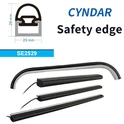
The shape matches the edge of the device: standard straight strip touch edges (width 20-50mm) are used for straight edges, bendable models (minimum bending radius <50mm) are used for arcs/corners, and thin touch edges (thickness <10mm) are used for narrow gaps to ensure that there is no gap with the equipment and cover all potential dangerous areas.
Environmental tolerance: For high and low temperature scenarios (such as cold storage and high temperature furnaces), weather-resistant materials (silicone is resistant to -60℃~200℃) are used; anti-ultraviolet additives are added to outdoor scenes to prevent aging; clean environments such as food workshops use washable and smooth surface designs without sanitary dead corners.
Collaborative linkage with equipment control systems
Signal compatibility: Supports multiple output types (normally open/normally closed contacts, NPN/PNP levels), and can be directly connected to control systems such as PLC and relays to ensure that signal transmission is not blocked by adaptation.
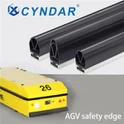
Response matching device performance: Calculate the required braking distance based on the device running speed. For example, when the AGV runs at 1m/s, the edge touch response time needs to be less than 50ms to cooperate with the braking system to control the parking distance within a safe range (less than 5cm) to avoid collision.
In summary, the two parts work together: the hardware design ensures that the edge touch itself "can accurately sense and respond quickly", and the scene adaptation and linkage ensure "reliable effectiveness in actual scenes", ultimately achieving the accuracy of safety protection.