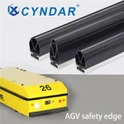
A 2.2 metre scissor lift, a guard lip at 400 mm, a 25 by 30 profile bonded under the bottom edge. Every descent it lands on whatever was left on the floor. The edge triggers, the controller clicks, and the platform still travels 60 mm before it holds.
The Travel You Actually Need
Nothing failed. The edge acted after 4 mm, and the machine needed 70 mm to stop. Approach speed 0.3 m/s is 300 mm per second; edge response 13 ms gives 4 mm, control and brake at 180 ms gives 54 mm. That is 58 mm, times 1.2, so the guard travels 70 mm before the movement is arrested. The edge has to survive 70 mm at a force a person can take. That is the selection, not the profile code.
A Profile Is a Force and a Travel
Each profile is two curves: the force that actuates it, and how much further it compresses before the sensing element gives up. A small section acts at 20 N and bottoms out in a few millimetres; a large one takes 70 N and absorbs 30 mm. Our range runs 20 to 70 N, with 3 to 5 mm on the normally open type and 15 to 25 mm on the normally closed. Match those to the force a hand can take and the travel the machine needs. Reverse the order and you buy a sensitive edge that stops nothing.
The Blind Spot Is at the Joint
One piece runs to 6 m, no more than five in series, and the joint between two pieces is not a sensing surface. Three edges of 2 m leave two gaps of roughly 30 mm. We have seen a run where the joint landed at the operator's reach: fine on the bench, blind where the hand goes. Move the joints, or use one piece. Coolant and spatter age the housing faster, so the sealing grade belongs in the choice.
Four Numbers Before the Part Number
Before a profile is quoted, get four numbers: the fastest speed the guard reaches, the time to stop from it, the force allowed at the contact point, and the space for profile and bracket. Section, actuation force, cable exit and IP grade follow from those.
An edge that triggers is not an edge that protects. On safety edges and safety mats, we are CYNDAR.