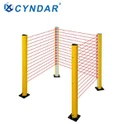
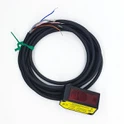
Through-beam photoelectric switch: It is composed of a transmitter and a receiver. The two are separated in structure. When the beam is interrupted, a switch signal change will occur. The typical way is that the photoelectric switches on the same axis can be mutually connected. Separate up to 50 meters.
Diffuse reflection photoelectric switch and through-beam type photoelectric switch are intuitively distinguished in appearance: opposite-beam is 2 sensor heads [one transmitter, one receiver]; retro-reflection is 1 sensor plus a reflector [reflector]; diffuse reflection It's just a single sensor. For general brand photoelectric switches, the detection distance is tens of meters, mirror reflection is tens of centimeters, and diffuse reflection is tens of millimeters. The through-beam type means that the transmitter and the receiver are placed separately, and the transmitter sends infrared light to the receiver at a certain distance to form a path. When there is an object blocking the light, the switch (application: security system, pipeline counting system) is triggered in reverse mode, and both the transmitter and the receiver are at one end. There are two types, one is the reflector type. A reflector is placed at a certain distance from the device to reflect the light from the transmitter back to the receiver, and the switch is triggered when an object is blocked (application: similar to the through-beam type).