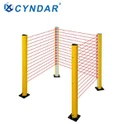
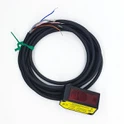
The earliest definition of lidar is LIDAR, English is Light Deteation and Ranging, and the Chinese meaning is "light detection and ranging".
In fact, a more accurate definition is LADAR: LAser Detection and Ranging, that is, "laser detection and ranging". This is a definition proposed in 2004, which is more in line with the concept of lidar.
Lidar is actually a kind of radar working in the optical band (special band), and its advantages are very obvious:
1. Extremely high resolution: Lidar works in the optical band and the frequency is 2 to 3 orders of magnitude higher than microwave. Therefore, compared with microwave radar, lidar has extremely high range resolution, angular resolution and speed Resolution
2. Strong anti-interference ability: the laser wavelength is short, it can emit a laser beam with a very small divergence angle (in the order of μrad), the multi-path effect is small (will not form directional emission, and the microwave or millimeter wave produces multi-path effect), detectable Low-altitude/ultra-low-altitude targets;
3. The amount of information obtained is rich: the distance, angle, reflection intensity, speed and other information of the target can be directly obtained to generate the multi-dimensional image of the target;
4. Can work all day: laser active detection, does not depend on external lighting conditions or the radiation characteristics of the target itself. It only needs to emit its own laser beam and obtain target information by detecting the echo signal of the emitted laser beam.
But the biggest shortcoming of lidar is that it is easily affected by atmospheric conditions and smoke from the working environment. It is very difficult to achieve an all-weather working environment.