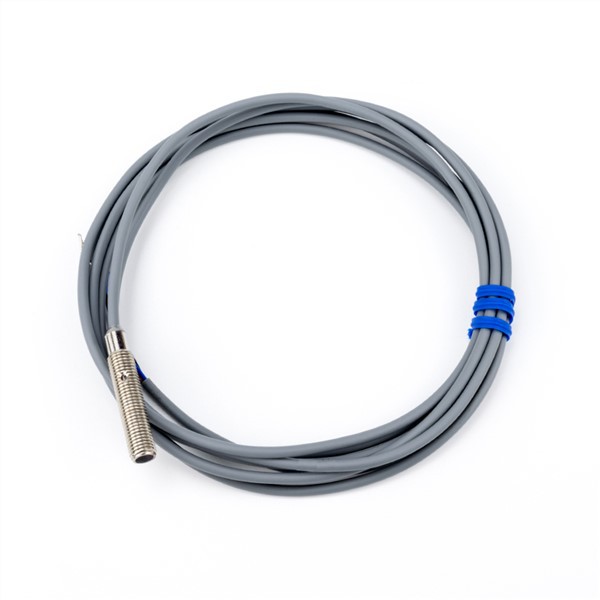
product | M18 capacitive sensor | M30 capacitive sensor | M30 copper tube capacitive sensor |
Installation method | Shielded/unshielded | Shielded/unshielded | shield |
Sensing distance | Shield 5mm / 8mm | Shielding 10mm / 20mm (adjustable) | Shield 2-10mm/2-20mm |
Indicator light | Unshielded 8mm / 15mm | Unshielded 15mm / 30mm (adjustable) | Unshielded 2-15mm / 2-30mm |
Operating Voltage | / | LED lights | LED lights |
No-load current | 20-250VAC | 10-30VDC | 10-30VDC |
Maximum load current | <2.5mA | <10mA | <10mA |
Leakage current | 300mA | 150mA | 150mA |
Voltage drop | 2.5mA | <0.01ma | <0.01ma |
On-off level | / | <1.5V | <1.5V |
Response time | / | 50 Hz | 50 Hz |
Switching hysteresis | 10ms | <1.5ms | <1.5ms |
Repeatability | / | <15% (SR) | <15% (SR) |
Protection level | <5%(Sr) | <5.0% (SR) | <5.0% (SR) |
Operating temperature | IP67 | IP67 | IP67 |
Temperature drift | -25°C -+70°℃ | -25°C-+70°C | -25°C-+70°C |
Overcurrent protection point | / | <10% (SR) | <30% (SR) |
Short circuit protection | 180mA | 180mA | |
Reverse polarity protection | YES | Yes | Yes |
Shell material | / | Yes | Yes |
Standard cable length | / | PBT plastic | Copper nickel plated |

Capacitive sensors use various types of capacitors as sensing elements to convert physical or mechanical quantities to be measured into a conversion device for capacitance changes. In fact, it is a capacitor with variable parameters.

1) Good temperature stability
The capacitance value of a capacitive sensor is generally independent of the electrode material, which is conducive to choosing a material with a low temperature coefficient, and because it generates very little heat, it has little effect on stability. The resistance sensor has copper loss and is easy to generate zero drift due to heat.
2) Simple structure
The capacitive sensor has a simple structure, is easy to manufacture and guarantees high accuracy. It can be made very small to achieve some special measurements; it can work in harsh environments such as high temperature, strong radiation and strong magnetic fields, and can withstand large temperatures. Change, withstand high pressure, high impact, overload, etc.; can measure ultra-high temperature and low pressure difference, and can also measure the magnetic work.
3) Good dynamic response
Because the electrostatic attraction between the plates with electrodes is very small (about a few 10^(-5)N), the capacitive sensor needs very little energy, and because its movable part can be made very small and thin, that is, the mass It is very light, so its natural frequency is very high, the dynamic response time is short, and it can work at a frequency of several MHz, which is especially suitable for dynamic measurement. And because of its low dielectric loss, it can be powered by a higher frequency, so the system has a high operating frequency. It can be used to measure high-speed changing parameters.
4) Non-contact measurement and high sensitivity
Non-contact measurement of the vibration or eccentricity of the rotating shaft, the radial clearance of small ball bearings, etc. When non-contact measurement is used, the capacitive sensor has an averaging effect, which can reduce the influence of the surface roughness of the workpiece on the measurement.
In addition to the above advantages, the capacitive sensor also has very small electrostatic attraction between the plates with electrodes, and the required input force and input energy are extremely small, so it can measure extremely low pressure, force, and small acceleration, displacement, etc. It can be made very sensitive, with high resolution, and can sense displacements of 0.01μm or less. Because of its low dielectric loss such as air, the zero residue generated when the differential structure is connected in a bridge type is extremely small, so it allows the circuit to carry out high magnification and makes the instrument have high sensitivity.

Hot Tags: capacitive proximity sensor, China, manufacturers, factory, buy, price, cheap