At CYNDAR, we are committed to breaking the limits of safety technology, protecting life safety, and preventing accidents.
Safety light curtains are widely used in the industrial field, and the importance of light curtain sensors is self-evident. Although safety light curtains have been widely used, not all workers can correctly operate various types of safety light curtains. In order to ensure the correct use of safety light curtains, in this case, we will explore how to apply our advanced safety light curtains, introduce the operation methods and precautions of safety light curtains.

Product Background

Safety light curtains are also a kind of photoelectric safety protection device (also known as safety protectors, punch protectors, infrared safety protection devices, etc.). In modern factories, people and machines work together on some potentially dangerous mechanical equipment, such as stamping machinery, shearing equipment, metal cutting equipment, automated assembly lines, automated welding lines, mechanical transmission and handling equipment, and hazardous areas (toxic, high pressure, high temperature, etc.), which can easily cause personal injury to operators.
Installation location planning
The following is the installation and use guide for the four-sided area safety light curtain used in packaging equipment, which is compiled based on safety requirements and industry practices:
1.Covering key hazardous areas
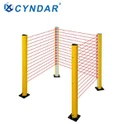
Install light curtains on the four sides of the packaging equipment (such as the feed port, conveyor belt, range of motion of the robot arm, etc.) to form a four-sided full-surround protection. It is necessary to ensure that the light curtain height covers the area that the operator may touch to avoid blind spots.
2.Alignment and fixing
Use a special bracket to fix the transmitter and receiver around the equipment to ensure that the light curtain is on the same horizontal plane and vertically aligned.
Avoid installation near highly reflective surfaces (such as metal plates) or high-frequency interference sources (such as motors and inverters).
Working principle of safety light curtain
Safety light curtain uses infrared emission and receiving mechanism to detect the entry of objects. Multiple infrared emitting tubes are installed at equal intervals on one side of the light curtain, and the same number of infrared receiving tubes are installed at equal intervals on the other side, and each infrared emitting tube is in the same straight line as the corresponding infrared receiving tube.
Signal transmission and circuit output in different states
No obstacle state: When there is no obstacle between the infrared emitting tube and the infrared receiving tube, the modulated signal (light signal) emitted by the infrared emitting tube can reach the infrared receiving tube smoothly. After the infrared receiving tube receives the modulated signal, its corresponding internal circuit outputs a low level.
Obstacle state: If there is an obstacle, the modulated signal (light signal) emitted by the infrared emitting tube cannot reach the infrared receiving tube smoothly, resulting in the infrared receiving tube not receiving the modulated signal, and the corresponding internal circuit outputs a high level.
No object state in the light curtain: When there is no object in the light curtain, the modulated signals (light signals) emitted by all infrared emitting tubes can reach the corresponding infrared receiving tube on the other side smoothly, so that all internal circuits output a low level. By analyzing the state of these internal circuits, it is possible to detect whether an object exists.
Infrared safety light curtains and the number of receiving channels
Theoretically, the number of infrared safety light curtains and receiving channels can be large, but considering the actual light curtain height and the distance between the upper and lower channels, it usually does not exceed 32.

CSAT Area Safety Light Curtains
Parameter summary of CYNDAR CSAT model area detection safety light curtain
1. Core parameters
Optical axis spacing: supports 40mm, 80mm, 200mm three options, which can be selected according to the application scenario requirements.
Detection distance: The distance between the transmitter and the receiver is customized according to the on-site installation conditions.
2. Output configuration
Output type: NPN, PNP or relay output can be selected to meet the interface requirements of different control systems.
Safety relay adaptation: When a safety relay with reset function is required, dual PNP output (two sets of independent PNP signals) must be selected to ensure redundant safety channel design.