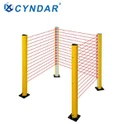
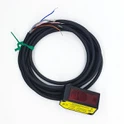
The SRTD22-99 achieves seamless integration with core safety components such as emergency stop buttons, safety door locks, and PNP light curtains/photoelectric sensors through modular hardware interfaces and universal signal processing circuitry. The specific technical approach is as follows:

1. Emergency stop button support: forced disconnection and signal monitoring
Interface Features: A dual-channel normally closed (NC) contact design supports emergency stop buttons compliant with the IEC 60947-5-5 standard, ensuring forced disconnection when the button is triggered. Internal monitoring circuitry also detects contact sticking faults (such as a single-channel disconnection timeout alarm).
Signal Processing: Input signals are optically isolated before entering the safety logic unit, achieving a response time of ≤10ms, meeting the safety level requirements for emergency stop functions according to EN ISO 13850 (up to PL e).
2. Safety Door Lock Support: Status Feedback and Interlock Control
Mechanical/Electronic Lock Compatibility: Compatible with electromagnetic safety door locks (such as latch locks with door position feedback) and mechanical code locks, the system detects the locked/unlocked state of the door lock via a PNP/NPN bipolar input circuit (switchable via a DIP switch).
Additional Functions: Supports "Request to Enter" signal input (e.g., an operator pressing a button to request door opening). This, combined with the device's operating status, implements interlock logic such as "Do not start if the safety door is unlocked" and "Immediately shut down if the door is opened during operation."


3. PNP Light Curtain/Photoelectric Sensor Support: Beam Interruption Detection and Fault Diagnosis
PNP Signal Processing: A dedicated differential amplifier circuit is designed for the PNP output signals of light curtains (such as two-hand synchronous detection light curtains) or photoelectric sensors (through-beam/reflective). This circuit suppresses electromagnetic interference (EMI) in industrial environments, achieving a detection resolution of 0.1ms.
Self-diagnosis function: Real-time monitoring of the light curtain's "normal beam", "interrupted beam" and "equipment failure" (such as power undervoltage, internal chip abnormality) three states, the fault signal is output to the alarm system through the safety relay.