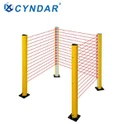
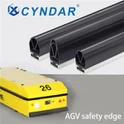
The SRTD22-99 supports switching between dual-channel (safety redundancy) and single-channel (simplified configuration) modes through hardware configuration and software parameter settings, adapting to different safety levels and cost requirements:

1. Dual-Channel Mode: Safety Redundancy Design for High-Risk Scenarios
Application Scenario: Suitable for equipment with direct human access to hazardous areas (such as stamping machines and robotic workstations) that must meet PL d/PL e or SIL 2/SIL 3 safety levels.
Implementation: Critical safety inputs (such as emergency stop and safety door) are connected via independent dual-channel circuits. The safety logic unit performs a "dual-channel comparison" (such as an XOR check) on the two signals, validating them only when the two signals match. A failure in either channel immediately triggers a safety shutdown.
Redundancy: The power supply, CPU, and output relays all utilize a dual-channel design with support for "hot backup" switching to prevent single-point failures from causing safety function failures.
2. Single-Channel Mode: Simplified Configuration for Low-Risk Scenarios
Application Scenarios: Suitable for protecting auxiliary equipment (such as conveyors and packaging machines) or areas not directly exposed to hazardous areas, with lower safety level requirements (PL a/PL b), or when reducing cost and wiring complexity.
Implementation: By disabling redundant channel detection through parameter settings, a single safety input signal is routed directly to the safety logic unit, reducing response time to ≤5ms while retaining basic fault detection (such as input disconnection alarm).
Flexibility: Supports mixed "partial channel redundancy" modes, such as dual-channel emergency stop and single-channel light curtain, balancing core risk protection with non-core functional simplification.