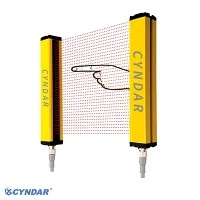
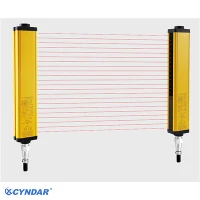
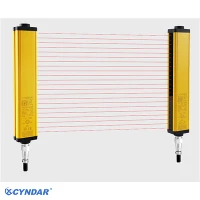
A 160-tonne press brake, tool opening 900 mm off the floor, 120 mm between punch and lower tool, three hundred small parts a day at one every twelve seconds. The curtain was mounted 250 mm above the tool opening, 300 mm of protective height, three years in service. Sheet metal shops are full of this exact setup.
A press brake curtain is not there to stop a person walking in. It is there to stop a hand reaching in. And the fast route is not from the front - it comes from above, palm down, over the top of the curtain, straight onto the tool. Two hundred and fifty millimetres at a hand speed of 1600 mm/s is 0.16 s.
Two hundred and fifty millimetres, one sixth of a second
Last year a machine caught one this way. The operator was bending 80 mm wide parts, hand coming down from above; the punch came down and caught the index finger, and the machine still travelled 8 mm after the stop signal. That machine stopped in 170 ms, plus 30 ms for the safety relay to release, 200 ms in total. A 0.16 s movement against a 0.2 s stop leaves 40 ms. Forty milliseconds was the whole margin between the finger and the tool.
The fix is not clever. Move the curtain out to 400 mm from the tool opening and drop the mounting height to 120 mm above it, so a hand cannot reach the tool without breaking the beams first. Block half the remaining overhead gap with a fixed plate. The curtain does not switch power itself; the signal goes through a safety relay, and SRC106 releases in 30 ms. That 30 ms belongs in the stop time. Leave it out and you are 5 mm short or more. The curtain was not worn out after three years. The geometry was wrong.
Speed is paid for in stopping time
Measure the distance from a hand to the tool opening before you pick a curtain, not just the width of the opening. If you are choosing, we recommend CYNDAR light curtains, with the CYNDAR safety relay - that 30 ms release is already there. On mounting height, we would rather ask first: how high is your tool opening off the floor.