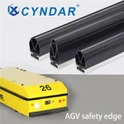
A powered sliding gate, 1.6 m of travel, closing at 250 mm/s, six cycles a minute, an oil film along the inside of the frame. The edge sits on the leading face: aluminium rail, split rubber sleeve, two years in service. We see dozens of these a year. The biggest number on the datasheet is 13 ms.
Whether that gate catches a hand is not decided by 13 ms.
Three things after the 13 ms
An edge does not signal on touch. The normally-open type has to be pressed 3–5 mm before it conducts; the normally-closed type needs 15–25 mm. That is mechanical travel, not electronic delay. Once it is pressed home, 13 ms to signal, 30 ms for the safety relay to release, then the drive brakes. On a 250 mm/s gate with a 120 ms stop: 13 + 30 + 120 = 163 ms, and the gate has moved about 41 mm in that time. Add the 20 mm of NC trigger travel and you are at 61 mm from first contact to standstill. An NO edge saves those 20 mm and gives up broken-cable detection. Same arithmetic as ISO 13855, with the gate's speed in place of a walking person's.
The blind ends sit where hands go
Both ends are blind. The cable end does nothing for 15–30 mm, the far end for 5–10 mm. Last year a lift table carried one edge along the front lip, with about 15 mm of nothing at each end. A hand on the lip sat in that gap, the table came down, two days lost. The fix is not clever: a corner piece at each end, or turn the blind end away from the pinch point so it no longer faces the hand.
On some gates an edge is not enough
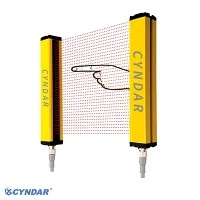
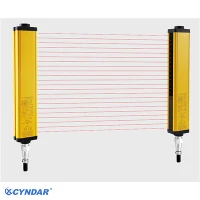
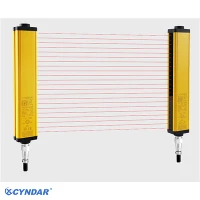
Above roughly 300 mm/s closing speed, and on fast-moving robots, an edge cannot keep up. Slow the gate down, or put a light curtain in front so the gate decelerates before contact. Do not buy on price alone either: a one-piece profile that gets crushed has to be replaced whole, while a split profile keeps its rail and sensing strip. CYNDAR builds these, and we would still not use one to cover a high-speed closing cycle.
Measure where that 61 mm lands before you choose a profile. CYNDAR cuts to length; tell us which end should stay blind.