Why use safety relays?

Brief description of accidents caused by mechanical arm wounding
At 5:29 a.m. on June 6, 2019, a smelting plant's smelting process 307 zinc ingot palletizing operation line robot arm main operator Jin Mou entered the safety door of the isolation fence that was never closed when the automatic palletizing unit was not shut down In the working area of the automatic coding machine, clean the site within the working radius of the robot arm. When walking to the section between the position where the coding machine takes the ingot and the robot arm, the ingot top device receives the zinc ingot transmitted by the water-cooled chain, and the signal is transmitted to the machine The arm and the mechanical arm automatically rotate to take the ingot, and instantly push Jin down on the top ingot device, and the zinc ingot grabbing fixture squeezes the left chest cavity of Jin.
Zhang, the zinc ingot packer, immediately activated the emergency stop switch and called nearby personnel to implement rescue together. After Yang, the squad leader of the 307 class of melting and casting process, arrived at the scene, he organized personnel to remove the anchor bolts of the robotic arm, hoist the robotic arm with an electric single beam, and rescued Jin at 5:48. 120 ambulance personnel rushed to the scene to carry out the rescue, and then rushed to the Second People's Hospital of the county and died after the rescue failed.
According to related reports, one third of all production accidents worldwide are mechanical safety accidents. If you open the Pandora's box caused by the accident, it is not difficult to find that the cause of the safety accident in machining can be completely simplified as: personnel exposure and equipment failure.
However, in this case, although the company clearly stipulated that “it is strictly forbidden to enter the work area space when the robotic arm is operating”, and “the operator can enter the operating radius only after the robotic arm is powered off”, but this also makes the machinery risk protection necessary to follow One of the principles of the isolation and stop principle, which can only rely on administrative measures to control, the actual on-site safety protection facilities are not perfect, the safety door of the guard fence and the robot arm are not effectively interlocked, and the operator is exposed to danger in this way...
Therefore, we can't help but assume:
Hypothesis: Install a safety door lock switch on the safety protection door
The safety door switch consists of two independent parts: the switch body and the switch's operating part. When the safety protection door is opened, the switch actuator is pulled out from the switch body, and the normally closed contact in the switch will be disconnected by a mechanical rebound device. Once the operating member is pulled out of the body, the controller immediately cuts off the power source to stop the movement of the components in the protective fence.
In the above accident, if a safety door lock switch is installed on the safety door of the guardrail, as long as Jin opens the safety door of the guardrail, the mechanical arm will power off and stop. With the help of the above locking and tagging procedures, it can ensure that after Jin enters the fence, the robotic arm is always in a power-off state, which not only complies with the relevant regulations of the company, but also ensures his own safety.
Hypothesis: Laying safety carpets within the operating radius of the robotic arm
The safety mat (mat) is a pressure-sensitive safety protection device. When a set minimum weight is applied to the safety mat, the switch will be turned off, and the controller will then send a stop signal to the protected machine to stop its movement. Reliably protect the operator from various potential hazards.
In the above accidents, if the safety carpet is laid within the operating radius of the robotic arm (a certain safety distance is required), then once Jin enters the dangerous area, the controller can make the robotic arm enter a power-off state to protect the safety of personnel .
There are no assumptions in life, and safety in production cannot be underestimated
Accompanied by familiarity with long-term repetitive operations and incomplete awareness of potential risks, workers are often easier to relax their vigilance, and the probability of occurrence of dangers caused by negligence or irregular operations will greatly increase!
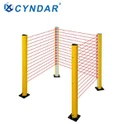
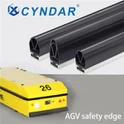
At this time, the necessity of installing safety interlocks is self-evident. As mentioned above, detection devices such as door locks, safety mats (mats), or safety edge contact, whose signals pass through safety relays, are interlocked with the robot operation signal, which can ensure that people are detected in time when they intrude, and the robot will not start up. Among them, the role of the safety relay is to ensure that the detection signal can be reliably transmitted.
CYNDAR safety relay products are designed in strict accordance with ISO 13849, IEC62061, IEC61508, etc., involving basic standards and application standards in terms of mechanical safety, functional safety, environment, electromagnetic compatibility, electrical safety, etc., and have been strictly evaluated by TÜV Rheinland Certification, safety performance level can reach SIL3, PLe, Cat.4.
At present, CYNDAR safety relay products can cover a variety of common safety sensing devices, such as emergency stop buttons, safety doors, safety light curtains, two-hand buttons (in accordance with EN 574 type ⅢC requirements), four-wire/two-wire safety mats, Safe touch etc.