Every few months somebody sends the CYNDAR team photos of a 1990s press brake with plywood taped over the foot pedal, then asks what it takes to get the machine through an audit. The press still runs fine. The guarding is the problem.
Retrofitting safety onto an old press isn't hard. Getting it wrong is easy, and nobody notices until an inspector walks the floor. Three devices come up over and over: light curtains, safety mats and safety edges. They answer different questions. Pick the wrong one and the symptoms surface months later - nuisance trips and a jumper wire, or a performance level that doesn't survive a second look.
Start with where the operator stands
The first question isn't "which sensor". It's "where does he stand, and what are his hands doing".
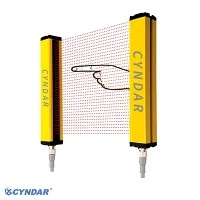
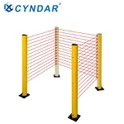
Feeding parts into a point of operation from outside? You're guarding an approach. A curtain in front of the hazard sees the hand before it arrives. Classic vertical guarding.
Standing on the floor beside a machine that can start on its own - a robot cell, a transfer line, a press on automatic cycle? You're guarding presence, not approach. Someone can already be inside the zone when the sequence begins. A curtain won't see him; he's behind it. A mat will.
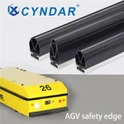
A closing gap - sliding guard, lift table, powered door - is a crush point. An edge on the leading face reverses the movement on contact, usually within a few milliseconds. Different job entirely.
Most retrofits need two of the three. A press brake gets a curtain at the front and a mat behind it.
Light curtains: the distance calculation is where projects fail
A curtain only works if it's mounted far enough away. ISO 13855 puts the minimum distance at approach speed times total response time, plus an addition that depends on resolution. With 14 mm resolution, 30 ms stopping time and 15 ms sensor response, you land near 100 to 150 mm. Step up to 30 mm resolution - cheaper, fine for body detection but not hands - and that distance grows.
The mistake we see most is a curtain mounted too close because the guard frame was already welded in place. It looks right. It passes a hand-wave test, because the machine does stop. It is still non-compliant: the hand reaches the hazard before the ram finishes stopping.
Runner-up: the curtain wired in series with the e-stop circuit and nothing else. Series connection is legal only if the whole chain's performance level survives it. On old machines, it usually doesn't.
Safety mats: the floor is the sensor
A mat is a four-wire resistance device. Step on it, the resistance between the two conductor planes changes, the controller drops the output. No optics to fog up, no alignment to drift. That's why mats survive in foundries and welding shops where curtains get coated in dust.
Two things to watch. A mat collects swarf and coolant; shorted by metal chips it reads as permanently occupied, the machine never runs, and operators lift the edge and tape it down. Specify the ramp profile and check the IP rating against what actually lands on your floor. Second, mats come in stock sizes and cells don't - CYNDAR cuts to the footprint, which costs lead time, so order early.
And a mat is not a fence. It detects presence on the floor. It won't stop someone reaching over the top of a guard.
Safety edges: fast, but short reach
Edges are the simplest of the three and the quickest to respond - a conductive or optical strip on the leading edge, wired to a controller, stops or reverses on contact. Under 10 ms is routine.
The limitation is coverage. An edge only protects the surface it is mounted on. If the guard can trap a hand at a corner, or the load shifts and opens a second gap, the edge won't see it. And a misaligned load bends the profile; a bent profile either trips constantly or stops tripping at all.
Where retrofits quietly go wrong
Four, roughly in order of how often we see them.
Reset buttons inside the guarded area. The operator has to reach through the hazard to reset. Reset belongs outside, with a clear view of the zone.
Muting without logic. Muting needs two independent sensors, correct sequencing and a time limit. One photoelectric sensor jumpered into the curtain input isn't muting. It is a bypass with a nicer name.
Performance level on paper only. A PL d curtain on a PL b relay is a PL b system. The weakest link governs.
Documentation that doesn't match the machine. The drawing shows a mat, the floor has a curtain. The audit fails on paperwork before anyone tests hardware.
A sequence that works
Identify the hazard and where the operator stands. Pick the device from that, not from the price list. Calculate the safety distance before drilling any holes. Choose a controller that matches the required PL and has enough inputs for what you actually need. Then wire it, test it, and write down what you did.
None of this is exotic. It just has to happen in that order.

CYNDAR builds safety light curtains, safety mats and safety edges for guarding retrofits. Send us the machine layout and we'll work out the safety distance with you.