A customer sent the CYNDAR team two drawings last week. Same hydraulic press, same 250 ms stopping time, same operator. One drawing put the safety mat 800 mm from the die. The other put it at 1700 mm. He wanted to know which one was wrong.
Both drawings came from people who had done the arithmetic. Only one of them had done all of it.
The missing 1200 millimetres
Ask a supplier how far a mat has to sit from the hazard and you usually get a number derived from response time alone. Multiply the stopping time by walking speed, add a bit, done. That is half the calculation.
ISO 13855 treats a floor-level device as a horizontal approach. The minimum distance is 1600 × T + 1200 − 0.4 × H, where T is the total response time from detection to standstill and H is the height of the detection plane. A mat lies on the floor, so H is zero and the last term vanishes. What is left is 1600 × T plus a flat 1200 mm.
That 1200 is not a safety factor somebody padded in. It is one stride, plus the forward lean of a body already in motion. By the time the mat registers weight, the person's upper body has travelled roughly that far. Detection at floor level is detection after the fact. The 1200 mm buys back what the physics already spent.
Run the numbers on a real press
Take the machine in those two drawings. Mat response under 30 ms. Relay release under 30 ms, which is what our SRC106 does. Press stopping time 250 ms, measured with a stop-time analyser rather than copied off a nameplate.
T = 0.03 + 0.03 + 0.25 = 0.31 s
S = 1600 × 0.31 + 1200 = 496 + 1200 ≈ 1696 mm
Call it 1.7 m. The drawing showing 800 mm is short by 900 mm, and 900 mm is enough for a person to step onto the mat, hear the valve shift, and still be leaning into the die when the ram arrives. Nothing about that installation feels wrong on site. The mat works. The machine stops. It just stops after the hands are already there.
Why the curtain beside it only needs 590 mm
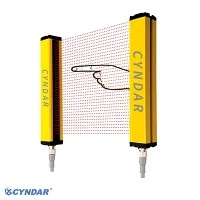
The same press, guarded with a light curtain at the front instead of a mat, lands somewhere completely different. Vertical approach uses 2000 × T + 8 × (d − 14), where d is the detection capability. At 14 mm resolution the second term is zero, so:
T = 0.015 + 0.03 + 0.25 = 0.295 s
S = 2000 × 0.295 ≈ 590 mm
Same machine, same stopping time, less than a third of the distance. That gap is not a product advantage. It is the difference between sensing a hand before it enters and sensing a foot after it has.
Which is why "a mat saves floor space" is backwards. A mat is the device you use when there is no room for a curtain frame, or when the hazard is approached from a direction a curtain cannot cover.
Three places the arithmetic goes wrong
The most expensive mistake is using electrical response time as T. On a servo press the electrical chain might total 60 ms and the mechanical coast another 300 ms. Use 60 and you will under-size every distance on the drawing by a factor of five.
Second, treating a mat as a zero-distance device because it sits on the floor where the operator stands anyway. The mat detects presence, not approach. It has no warning zone in front of it, only the 1200 mm stride term behind it.
Third, raising the mat on a plinth to shorten the distance. The − 0.4 × H term does shave a few centimetres off, but a raised mat is a step, and people step over steps. We have seen a 60 mm plinth turn a functioning guard into a trip hazard that operators learned to jump.
One floor in South China
A stamping shop in Guangdong had a mat 850 mm from the lower die, installed in 2019 and signed off by an auditor who checked wiring and not geometry. Two years later an operator stepped on it with his right foot as the press came down on a manual cycle. The machine stopped in time. He did not - his upper body was already over the die.
After the incident they recalculated and got 1.7 m, essentially the same figure as the drawing above. Moving the mat meant losing a staging table and re-routing a conveyor, which is the real reason the original 850 mm existed. Nobody had room for the correct distance, so the drawing quietly reflected the room that was available.
The fix was not a bigger mat. They pushed the mat out to 1.7 m, then mounted a two-beam curtain at 900 mm from the die as an approach warning that triggers a slow-down before the mat is reached. Two devices, two jobs.
What the response time is actually worth
CYNDAR mats respond in under 30 ms, and that number looks good on a quotation. In the distance calculation it is worth 30 ms × 1600 = 48 mm. Forty-eight millimetres out of seventeen hundred.
The number that governs the layout is how fast the machine stops, and that belongs to the press builder, not to us. A buyer who switches mat brands to gain 10 ms of response has bought 16 mm of floor and paid for a new supplier audit. We have watched that happen twice. Neither project got any closer to compliance.
Measure the stop time first. Everything else in the drawing is downstream of it.

CYNDAR builds safety mats, light curtains and safety edges for press brakes, shears and robot cells. Stop-time worksheets and distance calculations for your machine are available from our engineering team.