Two safety relays sit on the same DIN rail inside a 400-ton straight-side press. One is 22.5 mm wide. The other is nearly twice that and costs about four times as much. Coolant mist has been settling on that rail since 2019, and the press takes 180 ms to stop, measured with an analyser rather than read off the nameplate.
Both are sold as safety devices, and both arrive with the certificate that says so. The maintenance sheet lists them as interchangeable, which is roughly how the cheaper one got there.
Neither of them is what keeps hands out of that die. What decides it is whether the two signals arriving are really two channels, and whether anything downstream notices when they stop being two.
The relay only sees its own side
A guard circuit is a chain: the curtain or the mat, the relay, the contactors, the machine. Each part reports on itself. The relay acts on what reaches it. Behind the contactor, it is blind.
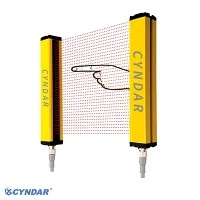
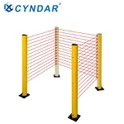
Timing makes the point. Curtain 15 ms, relay release 30 ms, contactor drop-out around 20 ms, press 180 ms to standstill. That is 245 ms. Under ISO 13855, a 2000 mm/s vertical approach with 14 mm detection puts 490 mm of floor between the light and the die.
The relay's share of that 245 is 30. Halve it and the guard moves 15 mm closer, about a hand's width. The press owns 180 ms. That is where the argument should be.
We have run CYNDAR's SRC106 on the bench, hot cabinet and cold, and release stays under 30 ms. It is a real number, not the decisive one. A press that takes 350 ms to stop needs 830 mm of floor whichever relay you bolt in.
Two channels that are not two channels
The fault we meet most often is not the wrong relay. It is two inputs taken off one source â cheap to do, and invisible afterwards. The relay reads two signals. The copper carries one. From that point a single stuck output keeps the machine running and nothing in the cabinet knows.
Curtains self-test every cycle, and the self-test ends at their own output. Past that point, whatever is there is not being watched.
We saw the result on a stamping line. Second channel bypassed at installation, one output stuck high, line still producing, so nobody looked. The other output failed two years later. The ram came down with a hand in the die area. He was quick.
A relay that reports channel status turns those two years into a week.
What the extra money buys
Not the contacts. Contacts are the cheap part of any of these units. The money is in cross-monitoring between channels, a feedback loop for the contactors, and diagnostics that make a single fault visible instead of silent. A box with contacts and nothing else sits there looking healthy with one channel dead, whatever the catalogue promises.
SRC106 is single-function: 3NO plus 1NC, 24 VDC, in a housing meant for a cabinet rather than the machine frame next to the coolant. Delayed release is a different product, SRTD22-99, not a setting.
Before the door closes
Write down what the next electrician will need: which device guards which hazard, what reset mode, what the machine does when the circuit opens, whether any line bypasses the circuit. A drawing carrying that survives staff changes. A drawing carrying only part numbers leaves the next man guessing.
The relay is the easy part. It arrives with a certificate. Its two channels do not.
CYNDAR builds safety relays and light curtains for machine builders who have to answer for the panel afterwards. SRC106 and SRDC31 cover single-function and multifunction duties; SRTD22-99 handles delayed release.